Most lists of family game night ideas hand you twenty titles and wish you luck. The trouble is that a great game on the wrong night still fails. A seven-year-old, a teenager, and two tired adults around the same table need the right kind of game, matched to the evening's energy.
So this guide is organized by how your family plays, and it covers the whole spread: fast physical challenges, card games, board games for mixed ages, zero-prep verbal games, and themed nights.
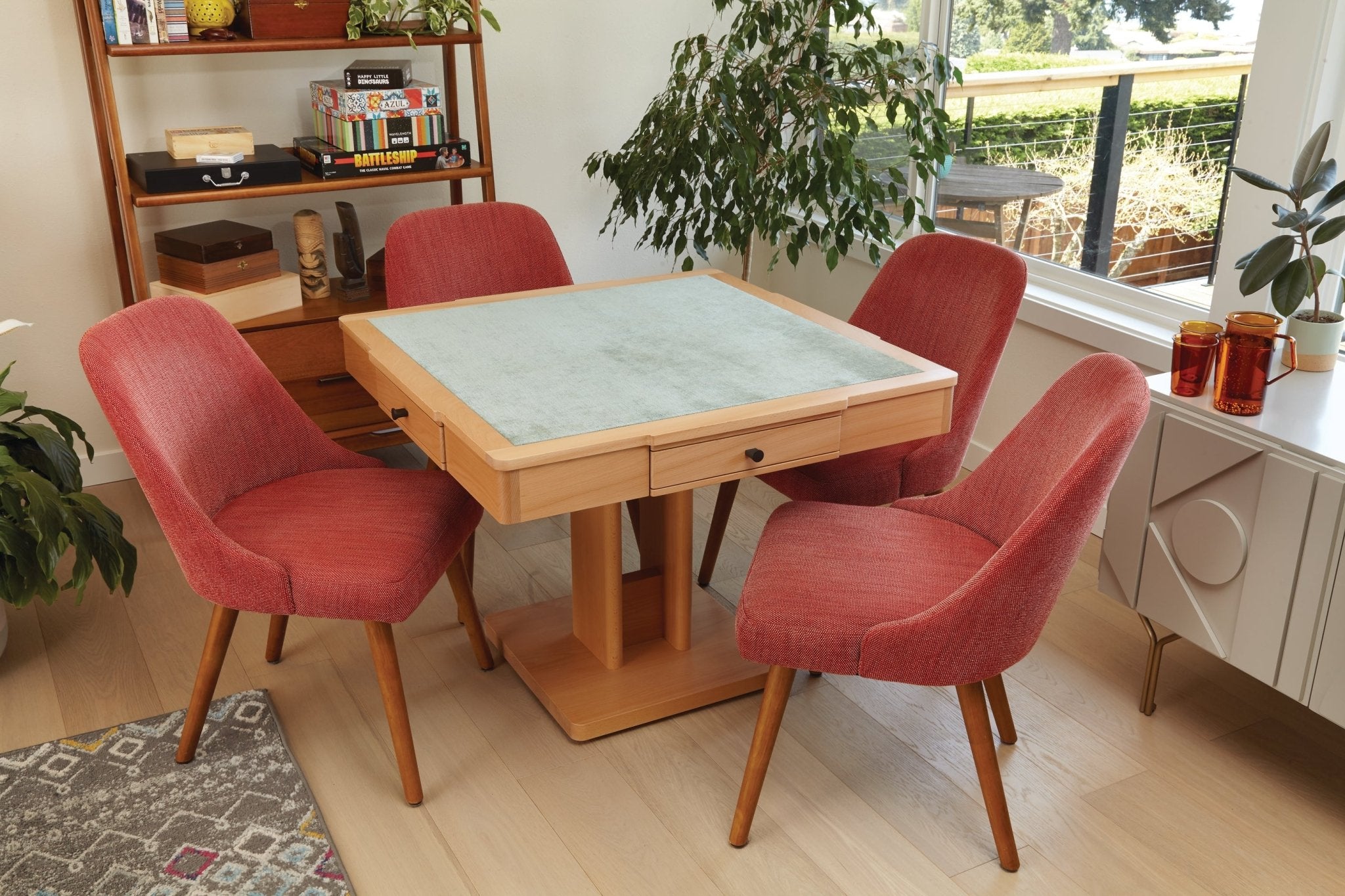
Families building a weekly tradition around a dedicated family game table will also find a section on setting up the space itself, because where you play shapes whether you keep playing.

Choosing Family Game Night Ideas by Play Style
Before picking a game, read the room. Who's at the table tonight, how much attention do they have, and how much setup will they tolerate? A rowdy Saturday afternoon and a low-key school night call for different games.
Here's the at-a-glance version:
|
Play style |
Typical length |
Ages that work |
Supplies |
|
Quick physical challenges |
5–15 min |
4 and up |
Household items |
|
Fast card games |
10–20 min |
5 and up |
A deck or one boxed game |
|
Board games |
30–60 min |
Varies by title |
The game, a real table |
|
No-supplies verbal games |
Any length |
5 and up |
Nothing |
|
Themed or tournament nights |
A full evening |
All ages |
Whatever games you own |
Family success depends more on energy level, age spread, and attention span than on how good a game is on paper. Match the style first.
Quick Games That Take Under 15 Minutes
The most common way game night dies is that setup takes longer than the youngest player's attention. Quick games solve that. They start in under two minutes, run in short rounds, and let a wiggly kid win or lose fast and go again.
Most of these work standing up or on the living room floor. A few of the card games below want a flat surface where cards won't slide, which matters more than people expect.
Household-Supply Challenges
Minute-to-win-it style challenges cost nothing and produce more laughter per minute than anything in a box. Set a one-minute timer and take turns. Six that hold up:
-
Cotton ball scoop: Move cotton balls from one bowl to another with a spoon, blindfolded. Easier dial: no blindfold for the five-year-old. Harder: teens use the spoon in their mouth.
-
Cup stacking: Build a pyramid from 21 plastic cups, then collapse it back into one stack. Younger kids build a 10-cup pyramid; teens race the clock.
-
Penny drop: Bounce pennies off the table into a cup. Move the cup closer for little hands, farther for adults.
-
Marshmallow towers: Tallest freestanding tower of marshmallows and dry spaghetti in three minutes. Teams pair a young builder with an adult.
-
Tape maze: Lay a painter's-tape path on the floor; players walk it heel-to-toe balancing a book on their head. Kids skip the book.
-
Spoon relay: Carry a ping-pong ball across the room on a spoon. Adults go backwards.
One challenge, two rule sets, and a kindergartner and a teenager compete in the same round without anyone getting bored or blown out.
Fast Card Games
A deck of cards and a kitchen table cover more game nights than any shelf of boxes. Five that scale across mixed ages:
-
Uno (2–10 players, 15 min, ages 5+): The rules teach themselves in one hand, and color matching means pre-readers play for real.
-
Spoons (3–8 players, 10 min, ages 6+): A standard deck plus spoons from the drawer. The grab-the-spoon scramble needs elbow room and a table that can take it.
-
Slapjack (2–6 players, 10 min, ages 4+): The youngest player usually has the fastest hands, which is exactly the point.
-
Skip-Bo (2–6 players, 20 min, ages 7+): Sequencing practice disguised as a race. Runs long with six; cap it at four on a school night.
-
Taco Cat Goat Cheese Pizza (2–8 players, 10 min, ages 8+): Pure speed and pattern recognition, so kids beat adults regularly.
Uno, Slapjack, and Taco Cat are shuffle-and-deal games you can play anywhere. Spoons and Skip-Bo want space to lay cards out, so save those for nights at the table.
Board Games That Work Across Mixed Ages
This is where most families overbuy and underplay. The question that matters is what makes a board game work for a family, and the answer has five parts.
Look for playtime under 45 minutes, rules you can teach in five, a luck-skill balance that lets kids beat adults honestly, no reading requirement for the youngest player, and a clear answer on cooperative versus competitive. A game can be brilliant and still fail four of those tests.
A few picks by weight:
-
Gateway games: Ticket to Ride, Sushi Go, Kingdomino. Real decisions, light rules, done in 30–45 minutes.
-
Party and social: Codenames, Just One. Word games where teams flatten the age gap.
-
Cooperative: Forbidden Island, Outfoxed. Everyone wins or loses together.
-
Classics: Clue, Sorry!, Sequence. Familiar, cheap, and available at every grandparent's house.
The cooperative shelf deserves special attention. If losing derails your night, and in houses with a competitive eight-year-old it often does, a cooperative game removes the problem at the source. The family beats the board together, and bedtime arrives without tears.
An honest note on the classics: Monopoly and Candyland stall with modern kids. Monopoly runs two hours past everyone's patience, and Candyland involves no decisions at all. Sorry! and Clue still landed. For Monopoly's trading itch, Ticket to Ride scratches it in a third of the time. For a fuller list of titles that clear the whole-table bar, our guide to the best board games for all ages goes deeper than this section can.
One practical footnote: footprint. Codenames fits a coffee table. Ticket to Ride wants the full dining table for an hour. And longer games, plus every jigsaw puzzle ever started, raise the multi-night question we'll get to in the setup section.
Scaling Down for Younger Kids
You rarely need the junior edition. Handicap mechanics stretch a real game down a few years: play in teams with a parent, deal hands face-up so an adult can coach, let the youngest take the fun job like rolling dice or moving pieces, or simplify scoring to first-past-the-post. Kids would rather play the real game badly than the kids' version well.
Picks for Teens and Adult-Heavy Tables
When the age floor rises, the ceiling can too. Codenames and Just One get sharper with teenagers. Social deduction games reward a table full of people who can bluff.
Catan works once everyone at the table is twelve or up, and a longer strategy game becomes a feature instead of a liability. Some age floors are real, though. A bluffing game with a six-year-old who announces her cards is a different game entirely.
No-Supplies Games for Zero-Prep Nights
Some of the best family games need nothing at all. No box, no pieces, no table. These carry you through car rides, waiting rooms, power outages, and the nights nobody planned.
Verbal and memory games first: Two Truths and a Lie, 20 Questions, Categories (name five breakfast foods before the count of ten), Fortunately/Unfortunately, and Kazoo That Tune, which is charades for your voice. Charades itself remains the undisputed champion of the genre. Split into teams and a whole evening disappears.
Storytelling games round it out. Build a story one line per person around the table, or run Mad Libs-style fill-ins if someone has paper handy. These games ask nothing and reliably produce the quotes your family repeats for years.
Themed Nights and Tournament Formats
Once game night is running, the next problem is keeping it from going stale. Three fixes, in rising order of commitment:
1. Add a theme
This is the easy layer. Decade night, movie-tie-in night, breakfast-for-dinner night, a backyard round in summer, holiday variants in December. What the theme signals is that somebody planned tonight on purpose.
2. Run a format
This is the deeper idea. A bracket tournament turns one evening into an event. A season-long leaderboard turns twelve ordinary Tuesdays into a campaign. A simple scoring framework any family can copy: 3 points for a win, 1 point for playing, 2 bonus points for choosing a game the family has never tried.
Total the points each season and hand over a family championship belt, or at least naming rights to the next pizza.
3. Rotate the picker
Rotation solves the arguing. Each family member picks the game one week per month, no vetoes. The picker also teaches the rules, which quietly builds a skill in every kid at the table.
Setting Up the Space So Game Night Actually Happens
Most family game nights don't fail for lack of ideas. They fail on logistics. The game lives on a high closet shelf, the table is covered in mail, the lighting is wrong, and the five-year-old can't reach her cards. None of that is a willpower problem. Work through these four fixes and the night mostly runs itself.
1. Get the table basics right
Is the table big enough for the player count with elbow room? Can everyone see under the evening light? Does the youngest kid need a booster to reach the middle? Do cards slide on the bare wood? A tablecloth, a felt mat, or a neoprene playmat fixes the sliding, and plenty of families play happily on a card table or the living room rug.
2. Solve the multi-night game
Anything that outlasts one sitting, whether a long strategy game or a thousand-piece puzzle, tends to get abandoned the moment the table has to be cleared for dinner. Families solve this a few ways: a folding table in a spare corner, a board that migrates to the top of a dresser, or furniture built for the job.
3. Consider furniture built for the job
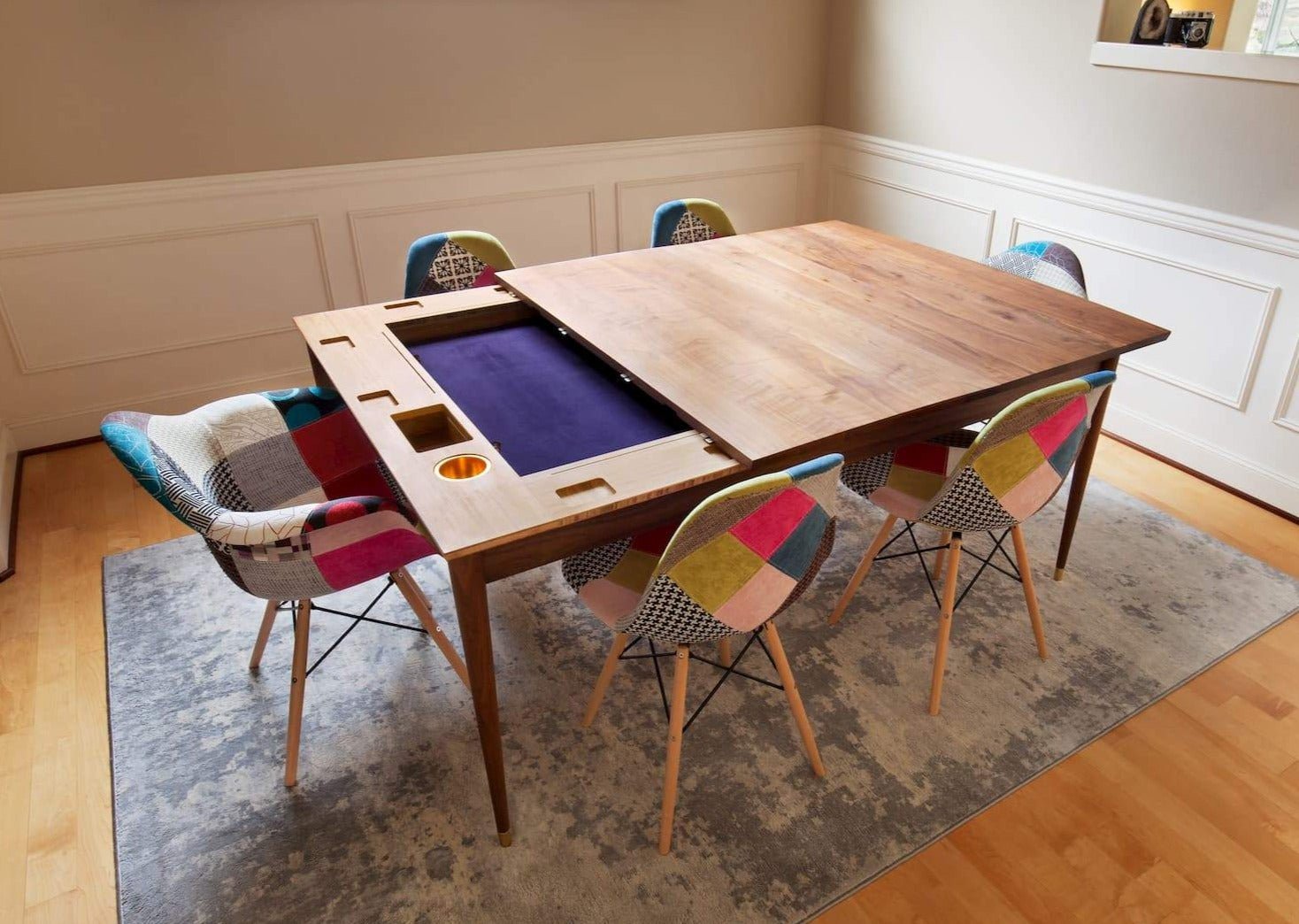
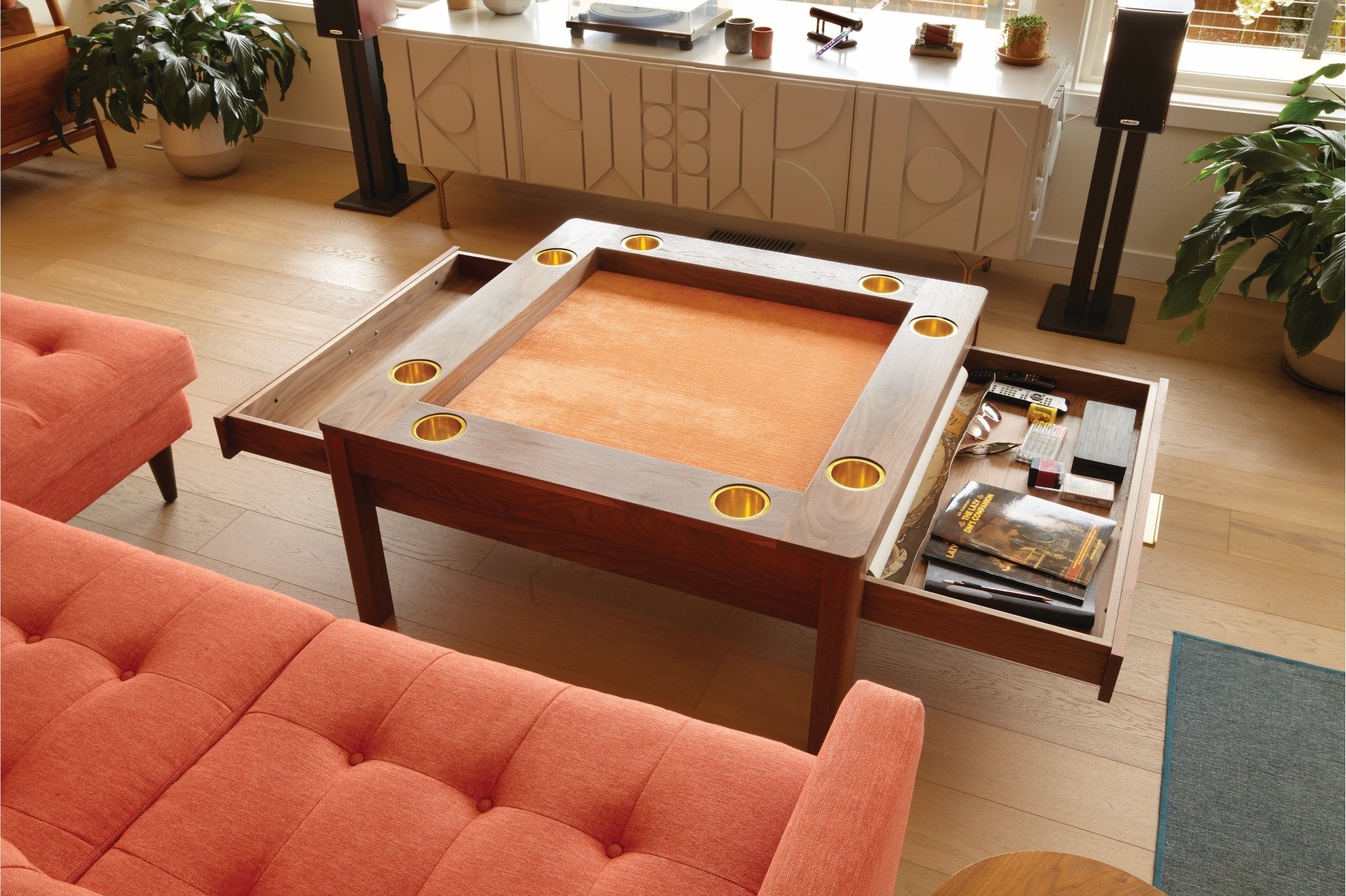
That last category is where we live. A convertible board game dining table works as a regular dining surface most of the week; lift the top off and there's a recessed, fabric-lined playing well underneath where a game or puzzle stays set up between sessions.

Our Dresden is built exactly this way, converting from dinner to game night in seconds, and the Firefly applies the same thinking at coffee-table height for families whose game night happens in the living room.
Details like cup holders and dice bins exist because spilled drinks and lost pieces end more game nights than boredom does.
4. Keep the games where kids can see them
Storage is underrated. Games buried in a closet don't get played. A dedicated spot on board game shelves at kid height keeps the collection visible and the choosing easy.
We've collected more approaches in our guide to board game storage ideas, and the principle underneath all of them is the same: visible games are played games.
Snacks and Drinks That Don't Ruin the Game
Snacks belong at game night. Greasy fingers on cards do not. The rule of thumb is dry, one-handed, and non-greasy: popcorn, pretzels, veggie sticks, trail mix, wrapped candy. The villains are anything oily, anything with powdered cheese, and open drinks without lids anywhere near the board.
The serving setup does most of the work. Give each player a small individual bowl instead of a shared one in the middle, and park drinks on a side table or serving tray off the playing surface. Cards survive, components survive, and nobody has to be the parent policing the chips.
Making Game Night a Habit Instead of a One-Off
A tradition is mostly logistics repeated. Four habits keep it alive:
1. Protect the time
Same night each week, hard start time, cap it at 45 to 60 minutes. Ending while everyone still wants more is what brings them back. If weekly feels too high a bar, start monthly. A tradition that happens beats an ambitious one that doesn't.
2. Set the house rules in advance
Devices in a basket at the door, rules taught before cards get dealt, tiebreakers decided before they're needed. And anyone can bow out early without a lecture, because a mandatory game night stops being fun.
3. Give everyone a role
The age spread and the sore-loser problem share a fix. Pair the youngest with an adult, run a cooperative week when competition gets hot, and hand non-players real jobs: dealer, scorekeeper, rules reader. Losing gracefully is a skill, and game night is the lowest-stakes classroom your kids will ever get for it.
4. Track it lightly
A shared list of games you own, a want-to-try list, and a visible scoreboard. Retire anything that stalls two nights running; rotate in one new game a month. If your game nights start pulling in neighbors and school friends, our guide to hosting a board game night covers the bigger-table version of the same logistics.
Start With the Night You Have
Match the game to the evening, keep the supplies within reach, and protect the time on the calendar. That's the whole system.
The screen-free hour matters more than the title on the box, and the memories your kids keep will come from the penny that bounced into the cup, the story chain that went off the rails, and the night the seven-year-old finally won for real.
Start this week with what's already in the house: a deck of cards, a roll of painter's tape, a bag of cotton balls. The fancier questions, which games to buy and where the table goes, can wait until the tradition has a pulse.