A game table can mean a 900-pound slate pool table, a folding card table, or a hardwood dining table with a fabric playfield hidden under the top. Each type asks something different of your home: floor space, weight, sometimes an outlet, and a room willing to hold it.
We build family game tables in our Edmonds, WA workshop, and we spend a lot of our time helping couples work out which type their house can carry. This guide compares the types of game tables on space, cost, construction, and what each does between game nights.

Game Table Categories at a Glance
Three questions sort the whole category. What do you play on it, one game or several? Does the playing surface convert to another use, like dining? And how permanently does it take over the room?
Those axes produce five structural categories you'll meet while shopping:
|
Structural category |
What it is |
Doubles as furniture? |
|
Stand-alone |
Built for one game at full size |
No |
|
Multi-game |
Several playing surfaces built into one frame |
Sometimes |
|
Combination |
Interchangeable or flip playing surfaces on one frame |
Sometimes |
|
Conversion (convertible) |
One game hidden under a removable dining or coffee top |
Yes, by design |
|
Tabletop / topper |
A portable playing surface set on furniture you own |
Uses what you have |
One naming warning before the roster. Retailers use game table, gaming table, and game room table loosely. A "gaming table" is often a PC desk, and "table games" is casino vocabulary. This guide covers furniture you play physical games on.
Dedicated, Convertible, and Multi-Game Tables
A dedicated, stand-alone table serves one game and serves it fully. Pool, shuffleboard, and foosball tables are the classic examples: regulation size, a purpose-built playing surface, and no second job. Play quality is the whole point, and it costs you a room.
A multi-game or combination table spends its budget on variety instead. One frame carries several playing surfaces, built in or swappable; a flip-top might hide bumper pool on one side and a laminate dining top on the other.
The trade-off is play quality. With the cost split across three to ten games, no single surface plays at a dedicated table's level, and dimensions rarely hit regulation. The moving parts also age first; hinges, latches, and swap mechanisms loosen early.
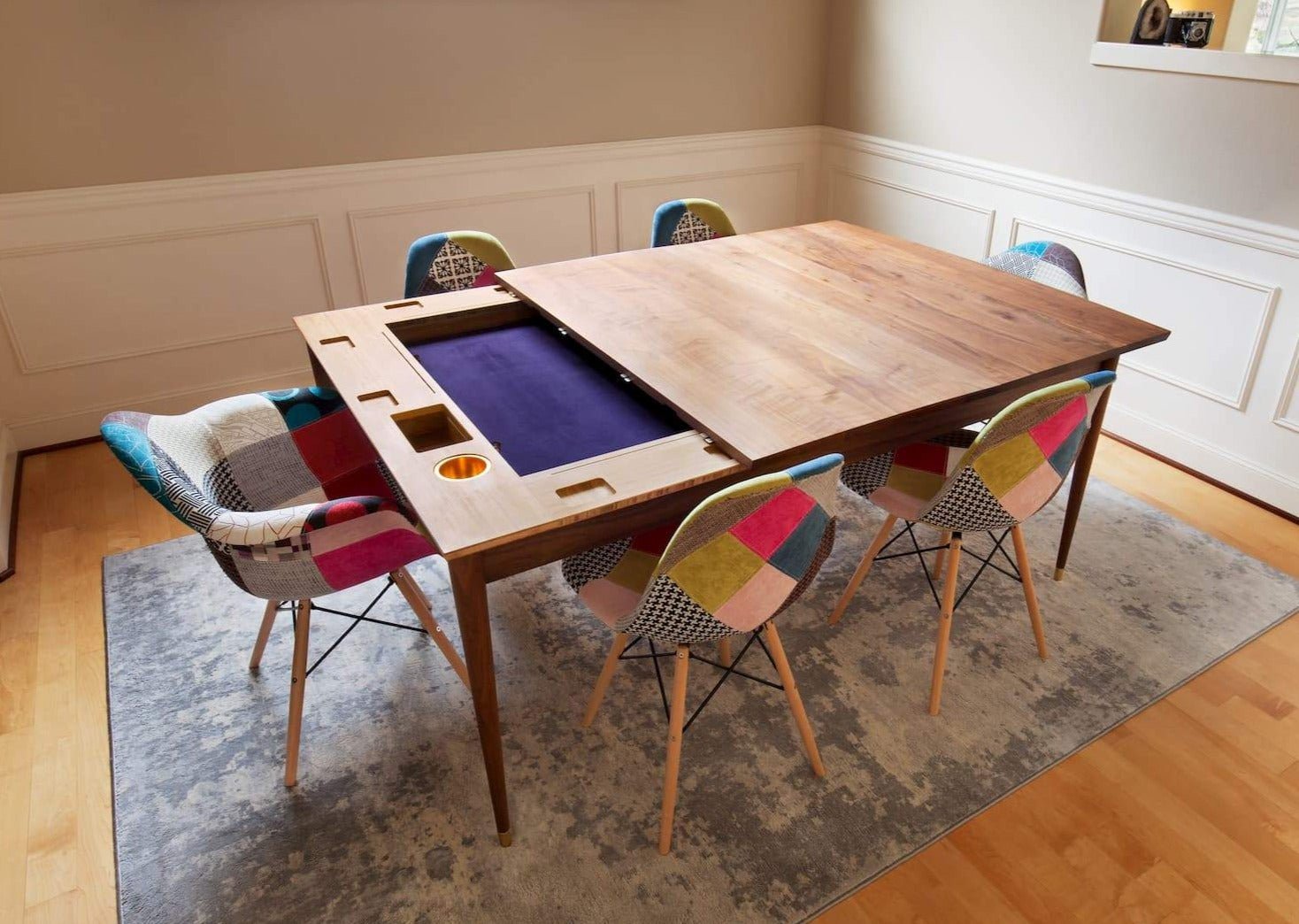
A convertible, or conversion, table trades in the other direction. It commits to one primary game at full size, then hides the play surface under a removable top so the piece works as a dining or coffee table the rest of the week. The cost sits in cabinetry and materials rather than variety.
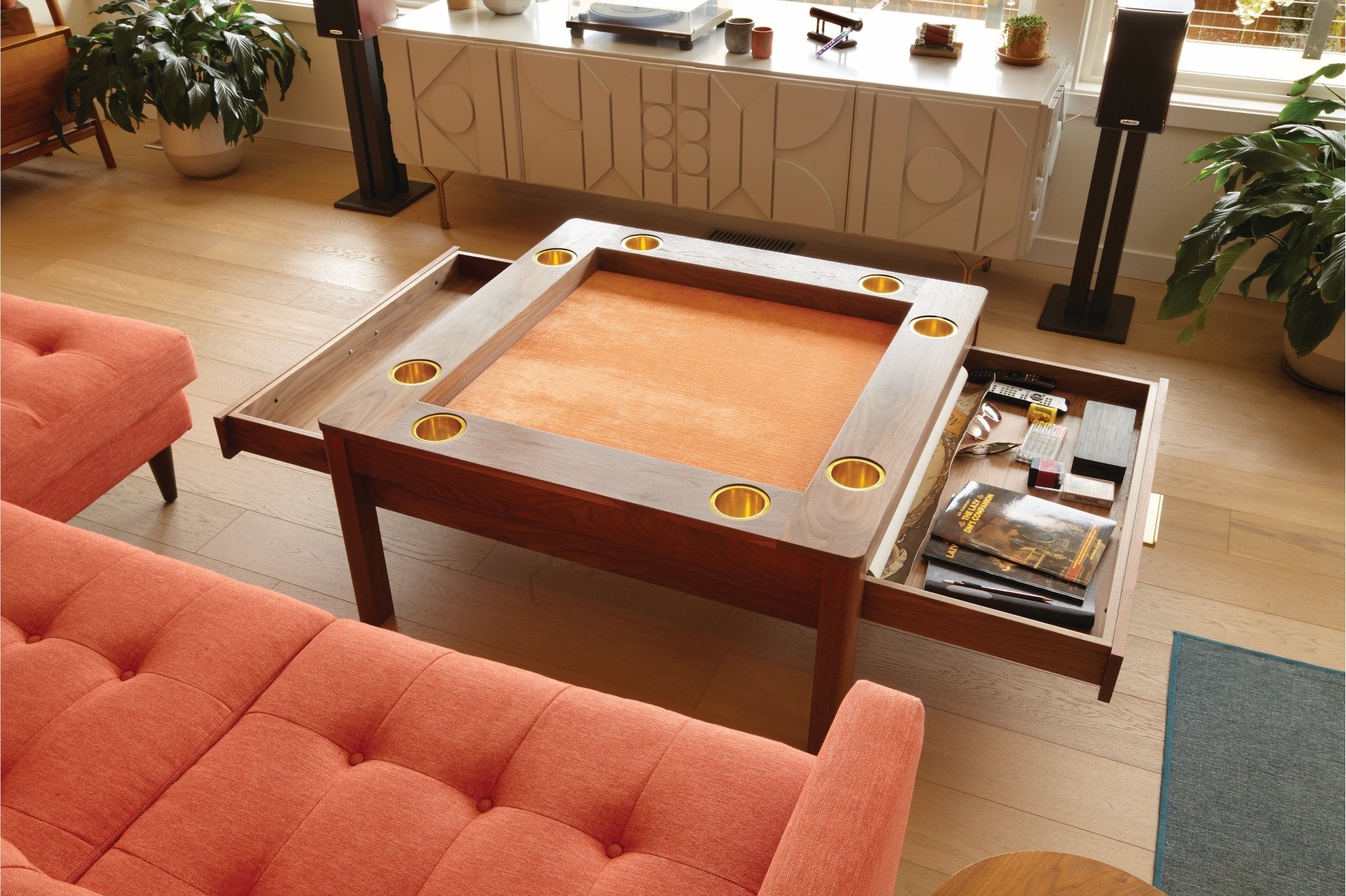
Our hardwood dining game tables sit in this category, and so does the coffee-table version of the idea. The Firefly puts a play surface beneath a removable top on a mid-century coffee table frame, with storage drawers below for the games themselves.
Each category fails somewhere. A dedicated table takes over a room, a multi-game table gives up play quality, and a convertible gives up portability, because once it becomes the dining table, it stays put. We argued the first and last of those out fully in our dedicated game room table vs. convertible dining game table comparison.
Frequency of use is a fair tiebreaker as well. A table in the room where you live gets played weekly; one in the garage gets played twice a year.
The Types of Game Tables, One by One
The roster below runs roughly in order of how often each type shows up in American homes. For every one: the space it needs, who it suits, the price band, and whether a convertible version exists.
1) Pool and Billiards Tables
Pool tables come in 7, 8, and 9-foot sizes, and the size choice is really a room-clearance decision. You need a full cue's length of room, about five feet, on every side, so even a 7-footer wants a room near 13 by 16 feet.
Slate versus MDF is the biggest quality divide. A slate playing surface stays true for decades, but it weighs 650 to 1,000 pounds and needs professional leveling at installation.
Pool suits teens and adults; expect a few hundred dollars for MDF and $2,000 and up for slate. Dining-top conversions exist, with a real height compromise. Bumper pool and snooker are the compact and oversized cousins.
2) Ping Pong (Table Tennis) Tables
A regulation table tennis table runs 9 by 5 feet, with mid-size and folding versions below that. Playing surface thickness, 12mm on cheap tables and up to 25mm on tournament ones, decides how true the bounce is.
Fold-and-roll storage is why ping pong is often the first game table a household buys; it can leave the room when the room needs to be something else.
A conversion top set over your existing dining table is the other space-saving route, and we compared that trade in game table topper vs. gaming table. All ages play. Folding tables start around $200, and tournament builds clear $1,000.
3) Air Hockey Tables
Blower strength and surface material separate a toy from a table that lasts. A weak fan means a puck that drags, and a soft laminate scratches into dead spots. Brunswick engineers developed the game between 1969 and 1972.
Two practical constraints get skipped in most guides: air hockey is loud, and the blower needs an outlet nearby. It shines with kids and mixed ages. Toy-grade tables run under $300; arcade-grade starts around $1,500 and usually adds electronic scoring. Convertible versions barely exist outside multi-game combos.
4) Shuffleboard Tables
Shuffleboard is the hardest type to fit in a normal room. Tables run 9 to 22 feet long, regulation is the full 22, and you need walking room at both ends.
The playfield is a thick hardwood slab with climatic adjusters underneath, because a board this long moves with humidity. Maintenance is ongoing: wax, the beads the puck rides on, plus seasonal adjustment. All ages can learn it in a round, which is its charm at parties. Expect $1,500 to $5,000 and up, with no meaningful convertible version.
5) Foosball Tables
Quality shows in the rod bearings, counterbalanced men, and cabinet rigidity. Hollow cabinets flex mid-game and the rods bind, while solid cabinets hold their leg levelers and stay square.
Foosball is standing play, so budget room on all four sides for players as well as rod travel. It suits kids through adults and takes abuse well. Hollow-cabinet tables start around $200; solid tournament cabinets clear $1,000. Convertible versions mostly appear as one surface inside combination tables.
6) Poker and Card Tables
Card tables split three ways: folding card tables, dedicated poker tables with padded rails, cup holders, and chip trays, and dining tables with a card surface underneath. Seating math matters here. An 8-player oval runs about seven feet long. A round four-player table fits a corner.
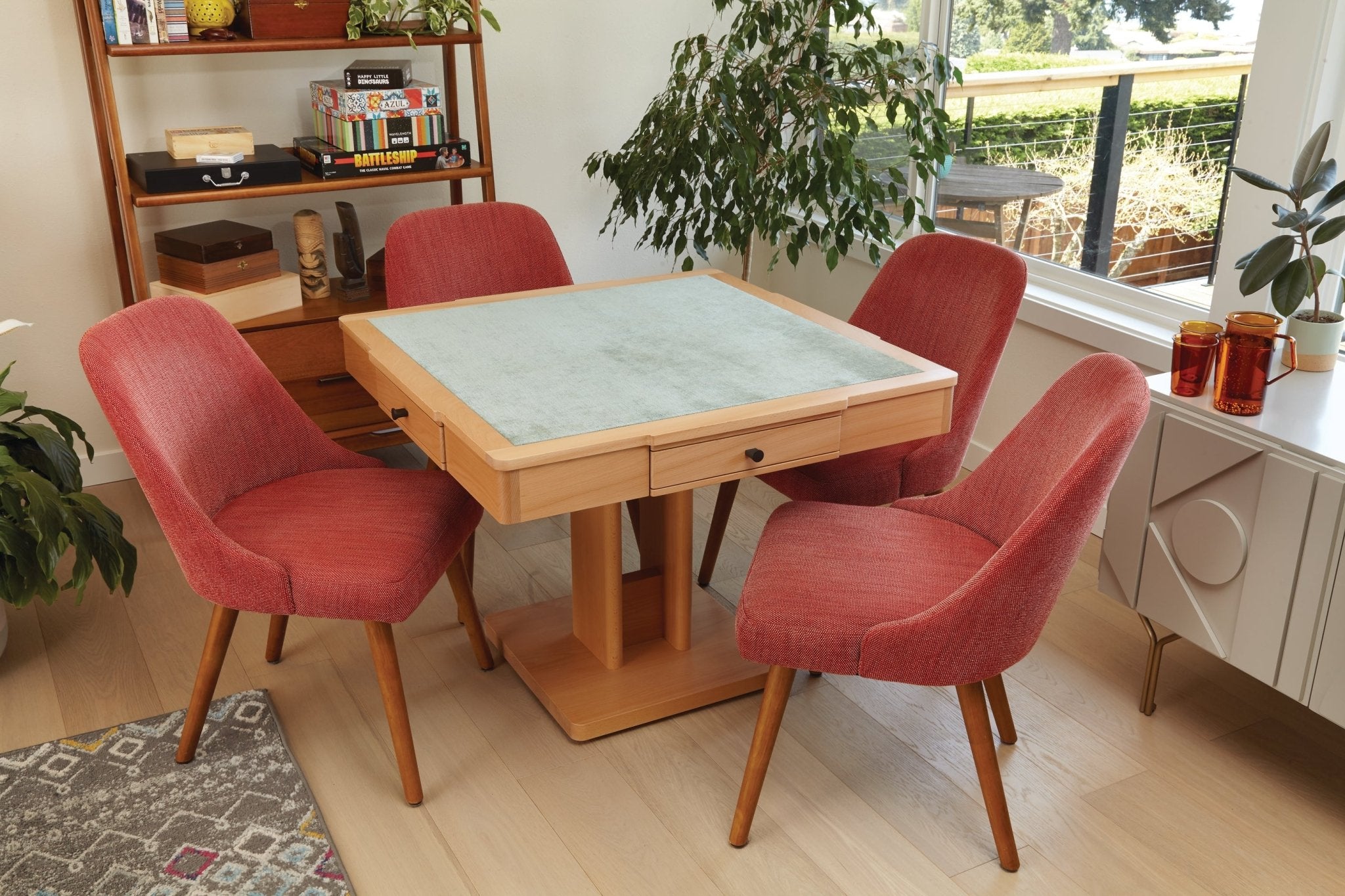
A dedicated poker table has an everyday-use problem: it sits idle between game nights. Reversible and convertible tops exist for exactly that reason. Our Mimosa solves it differently at den scale: a solid hardwood card table with drawers and folding legs, built to read as furniture whether or not cards are on it.
7) Board Game Tables
A board game table is built around a recessed playfield that sits below armrest height, usually felted, with cup holders and component ledges at the rail. Topper panels drop over the well to convert it to a dining surface.

The recess exists for two practical reasons: it protects a game in progress, and it keeps food and drinks off the play area. The Dresden is our hardwood convertible version, a dining table with a recessed playfield, velveteen on one side of the inset and speed cloth on the other, under solid topper panels.
If your search has narrowed to this type, our board game table buying guide walks the full decision.
8) Puzzle Tables
Puzzle tables span portable boards, felt roll-up mats, and furniture-grade tables with drawers and sorting trays. The core need is specific: leaving a 1,000-piece puzzle in progress without surrendering the dining table for a month.
There is real overlap with board game tables here. A recessed playfield with a lid serves both uses, which matters if you'd rather buy one piece of furniture than two.
9) Chess, Backgammon, and Domino Tables
These are the small-footprint types: two to four seats, an inlaid playing surface, and proportions that let them double as accent or side furniture in a living room. Mahjong and domino tables follow the same logic at four seats.
Inlaid wood versus a printed surface is the durability divide, since inlay wears in while print wears off. Prices track the woodwork, roughly $150 for printed tables and well past $1,000 for hardwood inlay.
10) Dartboard Cabinets and Non-Table Game Furniture
Darts compete for the same room budget without taking floor space. It takes wall and clearance instead: the throw line sits 7 feet 9.25 inches from the board face, plus protection for the wall and floor behind it.
Pinball machines, arcade cabinets, and skee-ball lanes are also bidding on that game room square footage. Casino-style blackjack and roulette tables are event-rental territory for most homes.
Space and Clearance Requirements
Your room eliminates more options than your preferences do, so measure before you shortlist. The numbers below include the clearance that makes a table playable, beyond the bare footprint.
|
Table type |
Playing surface |
Minimum room with clearance |
|
Pool (8-foot) |
44" x 88" |
13'6" x 17' |
|
Ping pong (regulation) |
5' x 9' |
11' x 19' |
|
Shuffleboard (12-foot) |
20" x 12' |
8' x 16' |
|
Foosball |
30" x 56" |
7' x 10' |
|
Air hockey (7-foot) |
4' x 7' |
8' x 11' |
|
Poker (8-player oval) |
42" x 84" |
10' x 13' |
|
Board game dining table |
52" x 78" |
11' x 13' |
The principle behind the numbers is the motion each game requires. Pool clearance is a cue plus a stroke, foosball clearance is a player's stance on all four sides, and a convertible dining table needs full chair pull-back at every seat, in both dining and game mode.
Three constraints hide outside the floor plan. Ceiling height matters if you want pendant lighting over the playing surface. Doorways and stairwells decide whether the table can be delivered at all. And slate's weight deserves a thought on older upper floors.
If the table shares a dining or living room, run the clearance check in both of the room's jobs, topper on and topper off. The measuring method costs nothing: tape the footprint on the floor, add the clearance, and walk it with a chair.
Materials, Construction, and the Cost of Durability
Solid hardwood, veneer, MDF, and particleboard age on different clocks. Hardwood dents, but a dent sands out. Veneer chips at the edges with no such fix, and MDF or particleboard swells wherever humidity finds a seam.
Joinery and hardware deserve more attention than they get. Leaves, toppers, rails, and drawer slides cycle thousands of times over a table's life, so look for hardwood joinery, metal-on-metal hardware, and levelers that adjust without tools. We build made-to-order for this reason: the joinery decides how long a table lasts, and it can't be upgraded later.
Playing surfaces are their own material question. Slate for pool, laminated playfields for air hockey, and cloth grades for card and board game tables. Speed cloth plays faster and wipes clean; velveteen is softer and quieter under dice.
Finish matters daily. A playing-area finish faces drinks, card sleeves, and repeated topper removal, and a thin factory coat shows all of it within a year.
Repairability is the real long-term cost variable. A solid hardwood top can be sanded and refinished decades in, while a worn veneer or swollen MDF table gets replaced. Compare purchase prices with that difference in mind.
Price Tiers and What Changes Between Them
Entry Tier: A Few Hundred Dollars
This is the mass-market home entertainment aisle: MDF construction, folding frames, and most multi-game tables. You get a playable surface for a few hundred dollars, and you accept the trade that comes with it. The levelers, hinges, and surface finish fail first, usually within a few years of regular play.
Mid Tier: Roughly $1,500 to $4,000
This is where play quality becomes real. Slate pool tables, branded dedicated tables, thicker playfields, and better cabinets all live in this band, and the spend lands between roughly $1,500 and $4,000 depending on the game. You're paying for a surface that plays true and hardware that holds up.
Furniture-Grade and Made-to-Order: The Top Band
Solid hardwood, real joinery, custom sizing, and a table that looks right in a living space. Here the spend goes into materials and construction rather than feature count, and the result is a piece the room keeps even when nobody's playing.
A $600 multi-game table and a $6,000 convertible hardwood table answer different questions. One buys variety for a rec room. The other is a permanent piece of furniture that also hosts game night.
Lead Times, Delivery, and Assembly
How long you'll wait depends on how the table is made. Mass-retail tables ship in days and assemble in an afternoon. Branded dedicated tables often run a few weeks. Made-to-order furniture is measured in months; our own delivery window runs about 24 weeks, so a table meant for December game nights is an early-summer order.
Installation is its own line item. Slate pool tables need professional leveling, and shuffleboards need climatic adjustment once they settle into your room's humidity. Check delivery terms too: curbside freight, threshold, and in-room are different services, and a stairwell or narrow doorway can decide between them.
Matching a Table to How You Play
Work through five questions and most of the roster falls away.
How many people play, and how often?
A weekly six-player group justifies a bigger footprint than an occasional foursome. Headcount decides the surface size and the seating before anything else does.
Does the room have another job?
A dedicated game room can hold a stand-alone table. A dining or living room points to a convertible. Most guides assume you have a basement or rec room to surrender, and a convertible is the answer when you don't.
One game or many?
A household that plays one game seriously gets more from a dedicated surface. A household that wants variety on a budget is the multi-game table's best use case.
Who plays?
For family game night with mixed ages, active tables like air hockey and foosball carry the energy. Adult game groups want seated play, a recessed surface, and chairs comfortable enough for a four-hour session.
Is the game left in progress?
Puzzles and long campaigns make a lid or topper non-negotiable, because the alternative is a hostage dining table. This is most of the reason D&D tables pair a recessed well with covers: a campaign map stays set between sessions while the household eats dinner on top of it.
A sixth question rides along with all five: how long should it last, and does it need to look like furniture? Both point at materials and joinery more than features.
The common mismatches run the same logic in reverse: expecting pool-hall play quality from a multi-game table, putting a dedicated table in a room that also hosts dinner, and buying the biggest surface the room can technically contain rather than the largest one with usable clearance.
Let the Room Make the First Cut
Measure the room, count your regular players, and be honest about whether the table has a second job. Those three answers do most of the narrowing before price enters the conversation.
What remains is a short list you can judge on construction: the materials, the joinery, the playing surface, and the maintenance each demands. A game table chosen that way fits the house on day one and is still getting played in twenty years.